Research statement · one page
Making the lab and the calculation talk to each other
I make biodegradable nanocomposite films and adsorbents in the lab, and I model functional materials with density functional theory. My goal is a workflow where calculations decide what is worth synthesising, and measurements correct the calculations.
The problem
Two problems I see from Bangladesh shape what I work on. Food packaging is overwhelmingly petroleum plastic that outlives its use by centuries, yet it still lets in the UV light that spoils what it holds. And clean water is not a given: the textile industry discharges dye-laden effluent, and in the coastal south salinity has crept into the ponds and groundwater households drink from.
Materials can answer both: biopolymer films that block UV and then return to soil, adsorbents that pull pollutants out and can be recovered. But finding the right composition is still mostly trial and error. A typical study casts a handful of filler loadings, characterises them, and picks the best. The search is slow, and it explains little about why one formulation works. Computation could narrow the search, but in most groups, mine included, synthesis and modelling run as separate projects that rarely inform each other.
What I have done
1 · UV-shielding biodegradable films
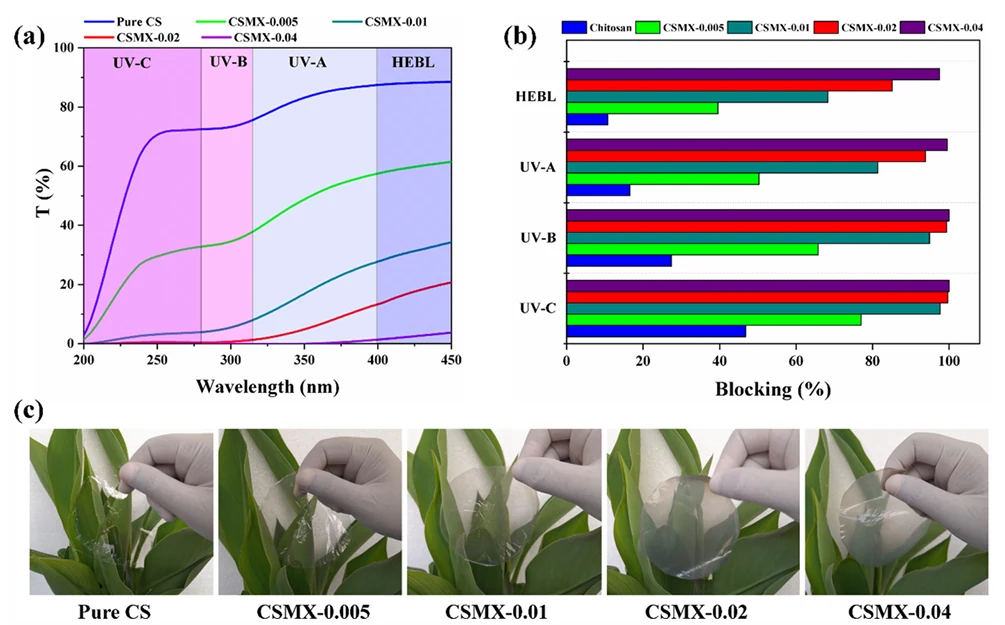
With Dr. Md. Kamruzzaman's group at GSTU, I worked on chitosan films reinforced with Ti3C2Tx MXene nanosheets, made by solution casting. MXene's negatively charged surface binds to chitosan's protonated amine groups through hydrogen bonding and electrostatic attraction, so even small loadings disperse evenly (confirmed by FTIR, FESEM and XRD). At the highest loading the film blocks nearly all UV-C and UV-B and about 99.5% of UV-A. It also gains strength (tensile strength 19.7 MPa), resists S. aureus and E. coli, and still degrades almost completely in soil within seven weeks. In a fruit-storage test it extended shelf life.
I have presented this line of work twice, including a first-place poster at the 3rd International Conference on Textile Science and Engineering on chitosan nanocomposite coatings for UV and antimicrobial protection of textiles.
2 · Water treatment
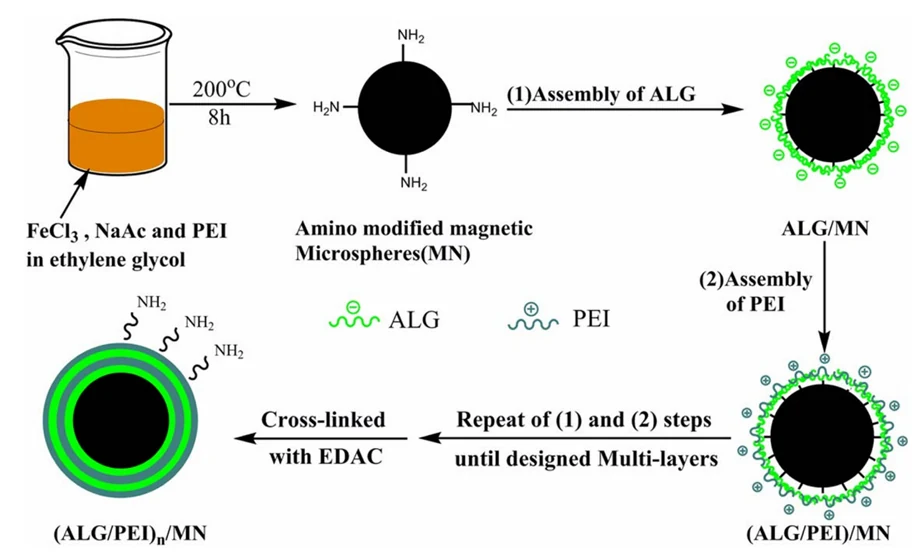
As first author of a review in Separation and Purification Technology, I compared how magnetic alginate composites are made and how they perform against dyes, heavy metals and other pollutants. These adsorbents combine alginate's binding chemistry with the ability to be pulled out of water with a magnet. Writing it taught me how much adsorbent performance depends on surface chemistry that is hard to see directly and easier to compute. In the lab I synthesise g-C3N4, green-route metal oxides and their Janus structures for photocatalytic treatment. Outside it, our team's IoT solar still for coastal households reached the top 10 of 244 at the BRAC Water Hackathon.
3 · First-principles modelling
My undergraduate thesis is a first-principles study, in VASP, of how magnetic ordering changes the physical properties of orthorhombic NdCuO3 perovskite. For each spin configuration I compute the band structure, density of states and optical response. Coming from chemical engineering, where quantum mechanics is a small part of the syllabus, I had to learn the theory and the workflow largely on my own. I now write that workflow up for other beginners.
What comes next
I want to close the loop between these threads. In graduate school I would like to work on questions like these:
- Interface design from first principles. How do MXene surface terminations (–O, –OH, –F) interact with chitosan and alginate? Computed adsorption energies and charge transfer could predict dispersion and oxidation stability before a film is ever cast.
- Screening fillers by their optical response. Calculate band gaps and absorption spectra of candidate perovskites, g-C3N4 heterostructures and Janus layers, then make only the most promising and check them with UV-Vis and XRD.
- Faster, more reliable methods. Hybrid functionals and DFT+U where plain DFT fails, ab initio molecular dynamics for polymer–nanosheet interfaces, and machine-learned interatomic potentials to reach realistic sizes.
I bring a chemical engineer's habit of asking whether something can be made at scale, hands-on synthesis and characterisation, working DFT experience, and the habit of building tools: Plot Bhai turns raw XRD, FTIR, UV-Vis and thermal data into publication-ready figures for anyone who needs them. I am looking for MS and PhD positions in materials science, chemical engineering and computational materials, in groups that combine synthesis with modelling.